English
 German
 French
 Italian
 Spanish
 Chinese
Research tools for
Home cage & welfare monitoring
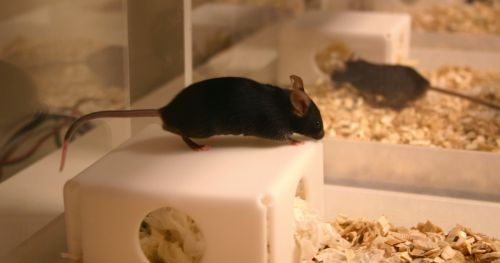
Testing animals in their home cage has several key advantages: it eliminates stress of new surroundings and allows for longer testing periods.
By performing tests in a home cage, you prevent bias introduced by handling of the mice or the novel environment.

The benefits of home cage testing
Behavior of laboratory rodents is often studied in well-controlled, short experiments, in an environment that is separate from the animal’s home cage. Handling of the animal, the stress of new surroundings, and the great variety in laboratory environments can make results difficult to interpret and can have a negative effect on animal welfare.
Executing tests in a home cage provides a solution to these problems. The PhenoTyper home cage is suitable for a wide variety of tests, including tests on learning and memory, or anxiety and depression. It is also ideal to monitor the daily rhythm or eating and drinking behavior of your lab animal over a consecutive period of time.

"The technical support and product knowledge of Noldus' staff is superior and platinum standard. Their commitment to helping customers troubleshoot software and hardware problems and their persistance in making sure a solution is found, is the reason labs like my own go to them for software and hardware."
Dr. S. Bonasera|University of Nebraska Medical Center, USA
Free e-book
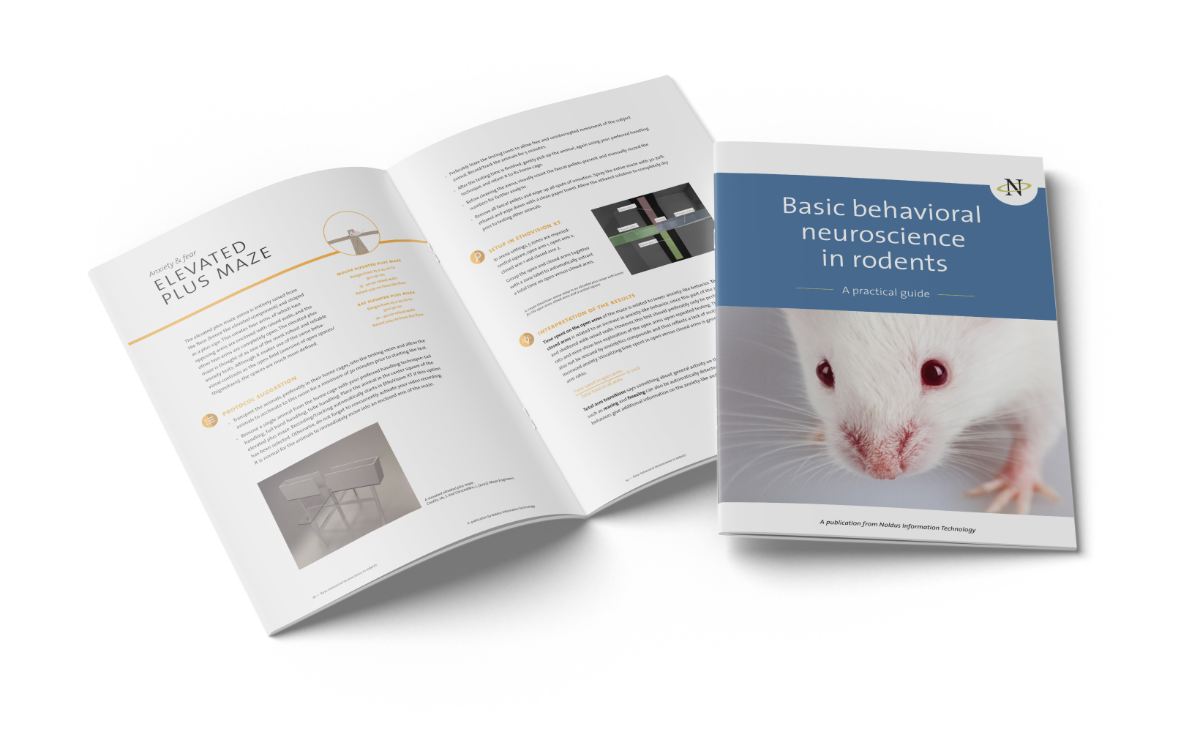
Basic behavioral neuroscience in rodents
How should I house my animals? What cage enrichment fits best? How should I handle them? And how does this all possibly affect their behavior in a behavioral test? It matters for example if you use individual or social housing for your rats and mice. In our free e-book, there is an entire chapter devoted to these specific questions. Enjoy reading!
Sophisticated protocols
PhenoTyper is powered by EthoVision XT, allowing you to automatically record the animal’s spontaneous behaviors. But it offers much more than that. EthoVision XT’s Trial & Hardware Control provides an easy-to-use programming environment to define protocols that completely automate your experiment. It allows you to control all TTL based hardware directly from EthoVision XT (with the use of the Noldus USB-IO box), such as the light and sound stimuli in the top unit of the PhenoTyper, the Noldus pellet dispenser, or any other TTL-based equipment you want to use.
Customize your desired home cage
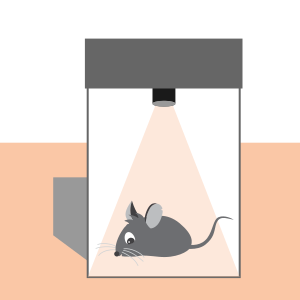
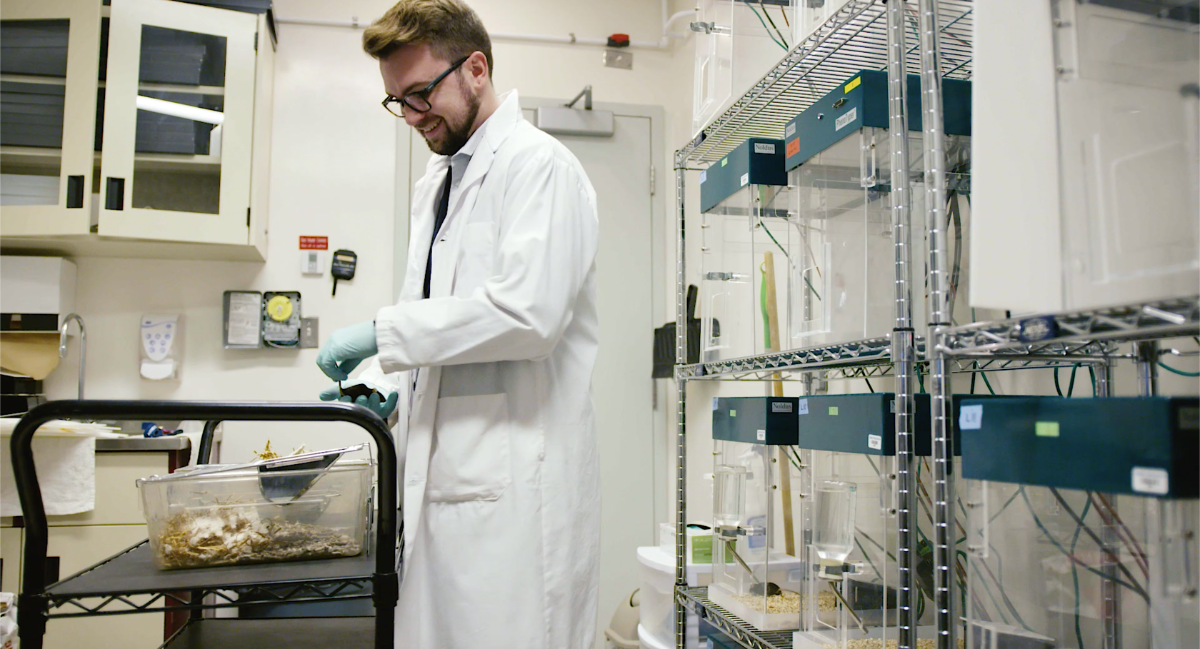
PhenoTyper is a complete hardware system. Each PhenoTyper home cage provides a home cage environment for a mouse or rat, with the availability of bedding, a shelter, and food and water supply. The top unit contains infrared (IR) sensitive video equipment and light and sound stimuli.
You can also expand your system with other components. Noldus offers a lickometer, a pellet dispenser, running wheel, and several shelters. All can be operated from, or used to provide feedback on the animal’s behavior to EthoVision XT.

We are celebrating that more than 1,750 PhenoTypers are part of research in labs worldwide!
Free case study
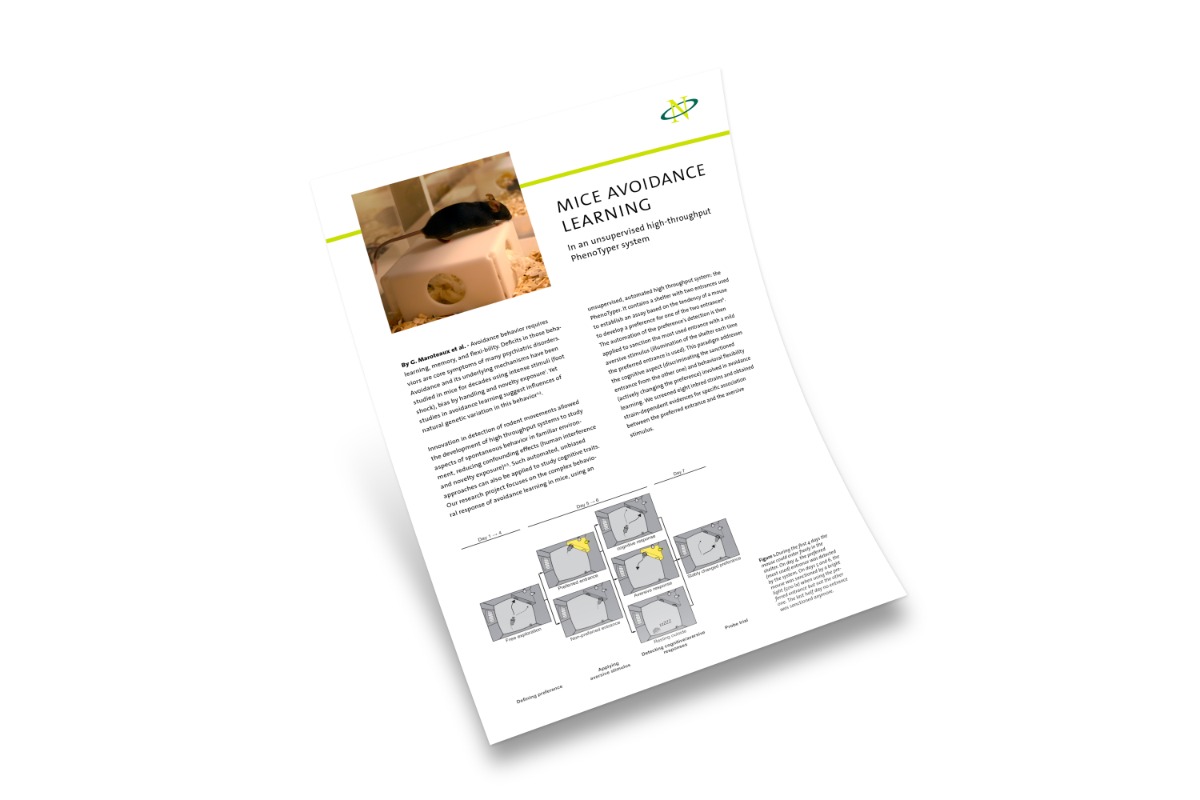
Mice avoidance learning
Avoidance behavior requires learning, memory, and flexibility. Deficits in those behaviors are core symptoms of many psychiatric disorders.
The research project presented in this case study focuses on the complex behavioral response of avoidance learning in mice, using an unsupervised, automated high throughput system: the PhenoTyper.
Download this free case study and learn more about PhenoTyper, EthoVision XT in behavioral research.
Dr. Do Rego: "Automatic measurements makes us gain in quality."
Dr. Jean-Claude do Rego and Dr. Jean-Luc do Rego of the Behavioral Analysis Facility of the University of Rouen (Service Commun d’Analyse Comportementale, SCAC), are evaluating the behavioral and functional activities of new pharmacological drugs.
Relevant blogs

Unraveling the chemistry of mood disorders
The most common psychiatric disorders are mood and anxiety related. However, the underlying mechanisms of these diseases are still largely unknown. This complicates the development of effective treatment and drugs.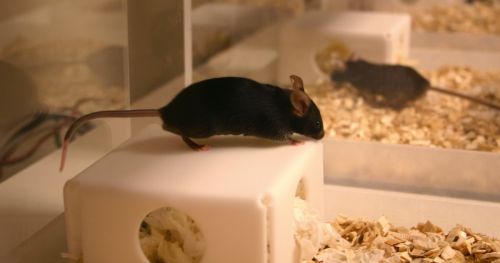
Non-invasive home cage testing of epilepsy in mice
Epilepsy is more than seizures; behavioral changes that occur in between seizures are rarely assessed. A new home cage study from the Baylor College of Medicine aims to change this.